

Precision, innovation, and layer-by-layer design
At CIM UPC we use the technology of Laser Powder Bed Fusion (LPBF) to manufacture metal and plastic parts of high precision and geometric complexity, from a bed of dust and laser energy or electron beam.
It is a key technology for research into new materials, process optimization, and the production of functional prototypes or high-performance final parts.
Equipment
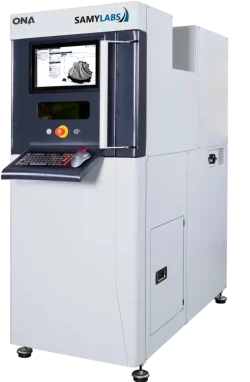
SAMYLABS ALBA 300
Description
The ALBA 300 is a metal 3D printer based on laser powder bed fusion technology (LPBF or SLM).
Designed for use in workshop, laboratory, or office environments, thanks to its compact size, standard electrical supply, and ease of transport, it enables the production of metal parts with complex geometries, good precision, and excellent surface quality.
The machine combines ease of use, low maintenance, and industrial-level performance, making it an ideal option for both prototypes and small production series.
Features
- Technology: Laser Powder Bed Fusion (Laser Beam PBF) on metallic materials.
- Laser power: 300 W.
- Build area: Diameter 160 mm × height 200 mm (approx., standard version).
- Layer thickness: 20–100 μm.
- Laser beam diameter: approximately 50 μm.
- Compact module: External dimensions approximately 730 × 1,550 × 1,850 mm.
- Weight: around 800 kg.
- Power supply: 230 V, 50/60 Hz, 16 A in standard configuration.
- Inerted print chamber: allows working with argon or nitrogen atmosphere to process metal powder without oxidation.
- Integrated software and control: includes SamyLabs Studio software for part slicing, real-time process monitoring, and report generation.
- Ergonomics and maintenance: designed for easy operation, part removal, and powder container cleaning, ensuring safe and simple use.
How does it work?
- Powder bed preparation: A very thin and uniform layer of metal powder is spread over the build platform.
- Selective fusion: A laser or electron beam precisely melts the areas corresponding to each section of the CAD model.
- Platform descent: Once the layer is solidified, the platform lowers by a distance equal to the layer thickness (usually 20–60 μm).
- Process repetition: A new powder layer is applied and fusion is repeated until the entire part is complete.
- Post-processing: After fabrication, the part is removed from the powder bed and may require thermal, mechanical, or surface treatments to achieve the desired final properties.
Applications in research:
New materials and alloys: Investigation of the behavior of metals and superalloys, as well as designing new materials with enhanced properties (strength, hardness, conductivity, etc.).
Process optimization: Study of manufacturing parameters to improve density, microstructure, and surface quality, reducing porosity and internal defects.
Complex geometries and lightweight structures: Development of topology-optimized or biomimetic structures, impossible to achieve with conventional processes.
Functional prototyping and validation: Production of parts with real mechanical properties for dimensional, functional, or testing validation.
Technological integration: Research combining the PBF process with other technologies, such as precision machining or thermal post-processing, to produce hybrid parts or improve finishing.
Biomedical applications: Design and manufacture of customized implants with porous structures that promote osteointegration and patient-specific anatomical adaptation.
Why do it at CIM UPC?
We have advanced equipment, expert knowledge, and experience in research projects and technology transfer with companies. We apply PBF to create functional and innovative parts with high technical performance.
Do you want to manufacture complex parts using Powder Bed Fusion?
Contact our team, and we’ll prepare a tailored proposal for you.
Do you want to manufacture complex parts using Powder Bed Fusion?
Contact our team, and we’ll prepare a tailored proposal for you.